Finding a pile of discarded wings on a windowsill — or a cloud of dark, fluttering insects pouring out of a porch column on a warm, still afternoon after rain — is one of the few pest problems that genuinely justifies the word emergency. Not because the swarmers themselves damage anything; they don't. Because a swarm emerging from inside your house means a colony has already been feeding in your structure long enough to mature, and that colony is still there after the flight ends.
Swarming termites have two pairs of wings the same length, straight-sided bodies with no pinched waist, and short, slightly beaded antennae. Flying ants have a narrow waist, bent antennae, and front wings noticeably longer than the back pair. The easier tell is the aftermath: termites shed their wings almost immediately, so you'll find loose wings heaped against glass, in spiderwebs, on sills, or in the sink. Where you found them matters more than how many. Swarmers drifting in through an open door from a neighbor's yard or a nearby stump is a different situation from swarmers coming out of a crack in your slab, a bath trap, a window frame, or a seam in the sheetrock. The second case means the colony has a direct route into your framing.
Louisiana carries a severe, well-documented Formosan subterranean termite problem — an invasive species that builds far larger colonies than our native termites, damages structures faster, and is harder to knock down once established. Formosan flights cluster around warm, humid evenings in late spring and are often drawn to porch lights, but our humid subtropical climate keeps termites and other structural pests active year-round rather than shutting them down over winter. A swarm in February is unusual but not impossible, and it's worth the same look.
Killing swarmers with aerosol solves nothing. The useful work starts with an inspection that establishes where the colony is tied into the building: probing trim and baseboards, checking the bath trap and plumbing penetrations, pulling the garage expansion joint and slab perimeter, looking at the sill plate and any wood-to-ground contact, and tracing mud tubes on piers or foundation walls. In Slidell, raised houses, slab-on-grade with poured porches, and homes near the bayous with high water tables each present different entry points, so the inspection shapes everything that follows.
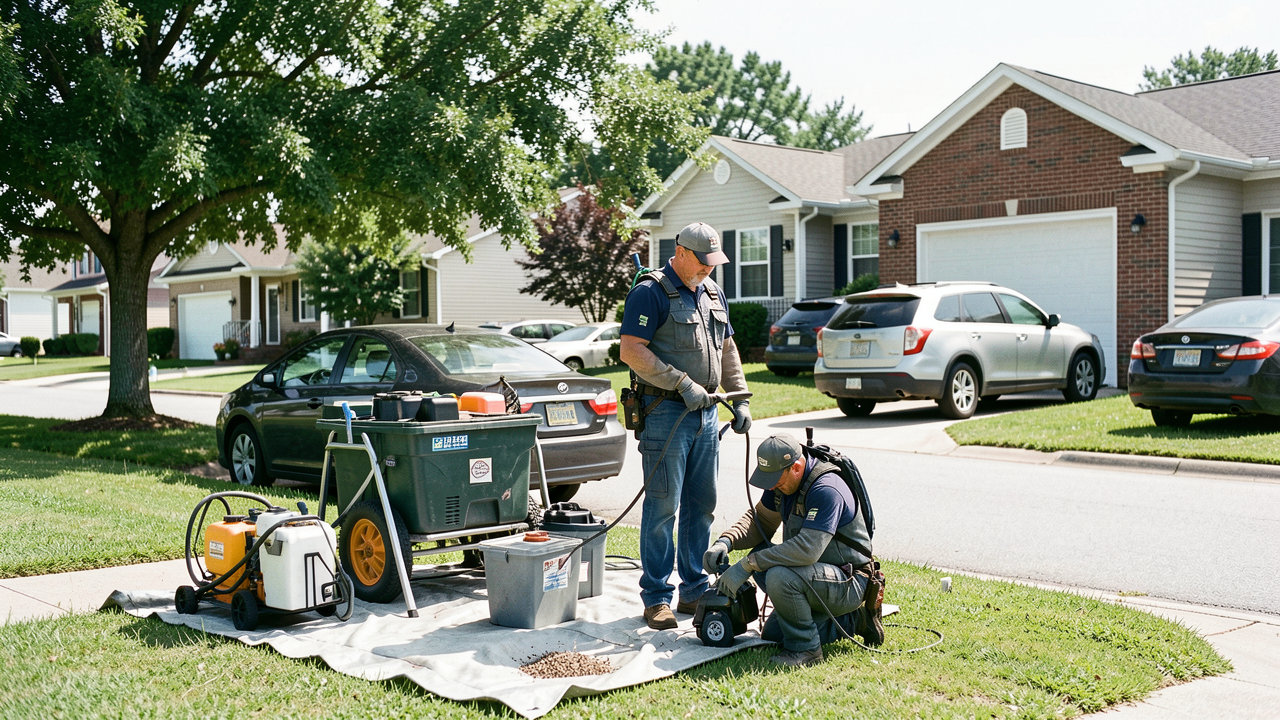
From there, treatment is usually a liquid soil termiticide applied as a continuous barrier — trenching soil beds, drilling and injecting through concrete at slabs, patios and attached garages — or a baiting system installed around the structure, or both. Direct foam or liquid injection into active galleries handles the colony you can see now. Which approach fits depends on construction type, slab layout, drainage, and whether there's an existing treatment history.
Linear footage of the foundation, amount of concrete that needs drilling, pier versus slab construction, crawlspace access, and whether the house also needs bait stations are the main cost drivers. Estimates are free, so get the scope written down before you agree to anything: which products, where they're being applied, how much of the perimeter is covered, and what the follow-up inspection schedule looks like. Ask specifically whether the quote covers the whole structure or only the active area — partial treatments are a common reason swarms return the next spring.
Subterranean Barrier Co. covers Slidell, Lacombe and Alton, and can get out same day while the swarm is still active, which is the best time to find the point of origin. Call to arrange it; payment options can be settled when you book.