If you found a swarm of winged insects around a porch light in May, or a mud tube running up a pier under the house, the question is not whether to act but how quickly. Formosan subterranean termites are established across St. Tammany Parish, and they behave differently from the native species: colonies are far larger, they forage over longer distances, and they will attack sound wood rather than waiting for moisture damage to soften it. Louisiana's problem with this invasive species is well documented, and the damage they cause is structural, not cosmetic.
Mud tubes are the clearest sign — pencil-width tunnels of soil and saliva running up slab edges, pier blocks, or the inside of a crawlspace. Tap suspect wood with a screwdriver handle; a hollow sound or a blade that sinks in means galleries underneath. Formosans also build carton nests, a chewed-wood-and-soil material they pack into wall voids, and these can hold moisture well enough that a colony survives above ground with no soil contact at all. That matters because a nest in a wall void or a flat roof will not be solved by soil treatment alone. Swarms here peak in the warm, still evenings of late spring, but the humid subtropical climate along the north shore means feeding carries on year-round rather than stopping over winter — a January inspection is as valid as a June one.
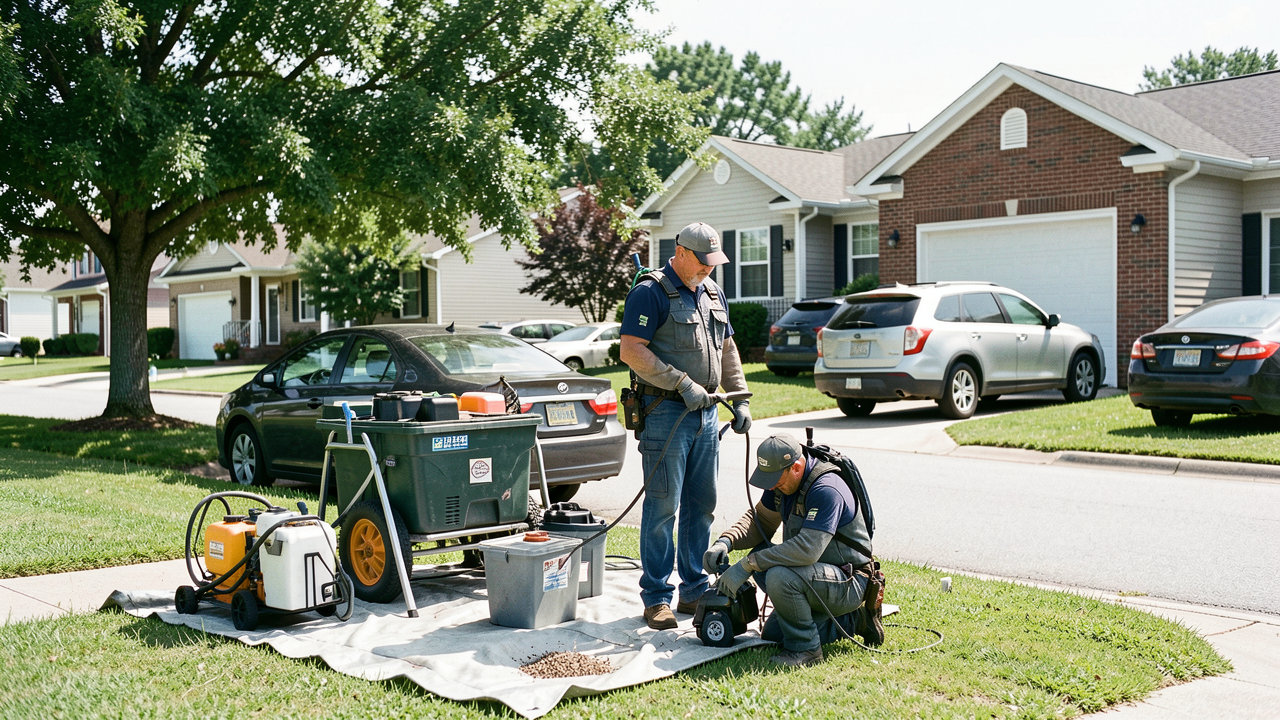
An inspection comes first, and it should be a real one: crawlspace or slab perimeter, bath traps, expansion joints, plumbing penetrations, attic and any flat-roof areas, plus the fence line, railroad ties and stumps nearby that often hold the real colony. From there the usual choices are a liquid soil termiticide applied as a continuous treated zone, a baiting system, or both together. A liquid barrier on a slab home means drilling the slab perimeter and any patio or garage pour on grade, rodding the soil outside, and treating bath traps from inside. On a pier-and-beam house in older Slidell neighbourhoods, more of the work happens underneath. Baiting works on the colony rather than the structure and suits properties where drilling is impractical or where repeated swarms suggest a nest off the property line. Carton nests found in voids usually need direct injection as well.
Price is driven by linear footage of foundation, construction type, how much concrete has to be drilled, whether there is a crawlspace and how accessible it is, and whether you need live-colony elimination or a preventive barrier. Add-ons like wood treatment to exposed framing, or returning to treat a detached garage or shed, move the number too. Estimates are free, so get the scope in writing before you commit.
Ask what product is going in the ground and whether the treatment is a continuous zone or spot application — spot treatment of a Formosan infestation rarely holds. Ask how slab penetrations will be patched. Ask what happens if swarmers reappear next spring, and get the follow-up inspection schedule stated clearly. If a company cannot explain where they think the colony is, they are treating a symptom.
Same-day service is available, and we take a range of payment methods. Call to arrange an inspection in Slidell, Lacombe or Alton — enquiries are by phone only.