Swarms are usually how it starts. A warm, still evening after rain, and suddenly there are winged insects piling around the porch light or stacking up in a window sill, shedding wings in little heaps on the sash. That is the point most people in Slidell pick up the phone, and it is worth picking it up quickly — a swarm means a colony that has been feeding somewhere nearby long enough to mature. Termite swarm emergency treatment is not about killing the fliers you can see, which die on their own within hours. It is about finding where they came out and what has been eating while you weren't looking.
A termite inspection is a slow walk, not a glance. Inside, that means tapping and probing accessible framing, baseboards, door jambs, window sills and bath walls, checking for hollow sound, blistered paint, buckled trim and pinholes. Outside, it is the foundation perimeter, piers, slab penetrations, expansion joints, soil grade against the siding, and anywhere wood meets dirt — fence returns, deck posts, stair stringers, the fascia under a leaking gutter. Mud tubes running up a block pier or across a slab edge are the clearest sign of subterranean termites. Drywood termites leave something different: tiny gritty pellets, like coarse sand, collecting below a hole in trim or in an attic rafter. Those two findings send the job in different directions, which is why the inspection comes first and drives everything after it. Estimates for the work are free, and we can often get out the same day when there's an active swarm.
Louisiana has a well-documented and genuinely severe Formosan subterranean termite problem. This invasive species builds far larger colonies than our native subterranean termites, forages over a wider area, and will build carton nests above ground inside wall voids where there's a steady moisture source — a slow shower pan leak, a chronically wet wall under a window. Formosan termite treatment usually has to deal with that aerial nest as well as the soil, because the colony may not need ground contact to keep going. A treatment plan that would hold a native colony can fall short here, and the difference shows up a year or two later.
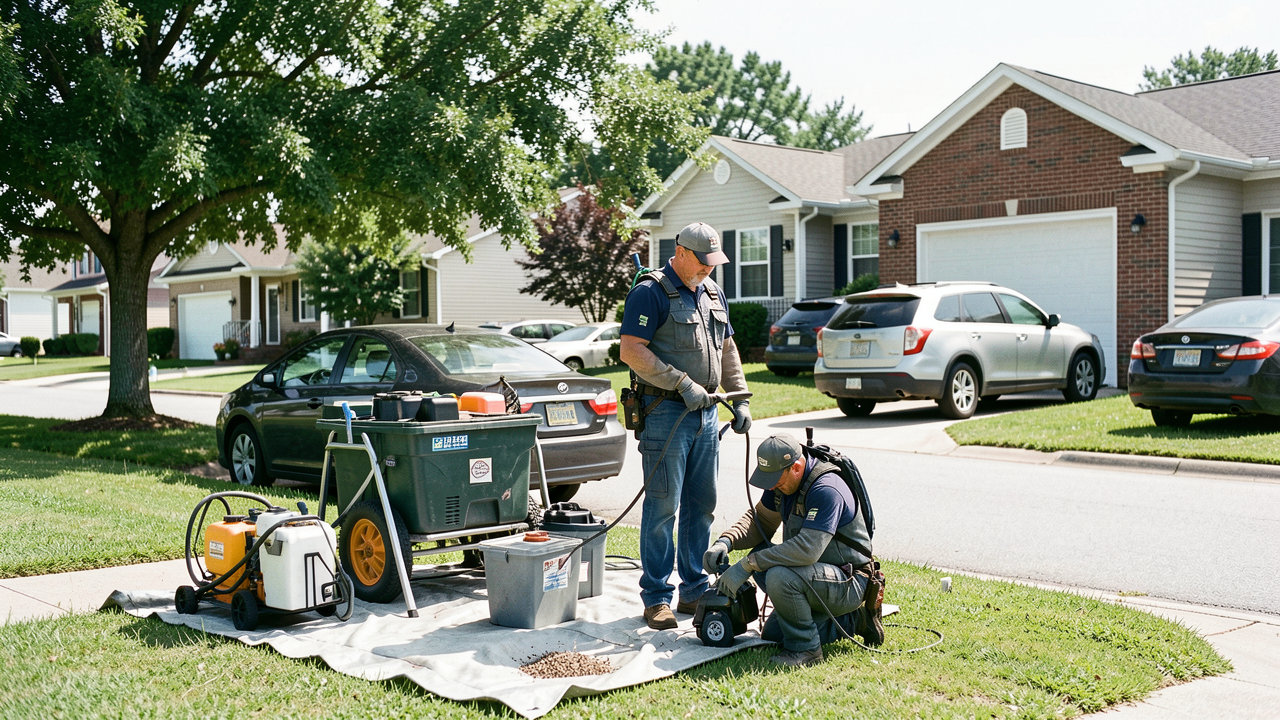
A liquid termite barrier treatment means a continuous treated zone of soil around and under the structure. On a slab home that involves trenching the perimeter and drilling through slab at expansion joints, bath traps and any patio or driveway poured against the foundation, then injecting at rate. On a pier-and-beam house it means trenching and rodding around piers and the perimeter wall. Done right it is thorough and messy and takes most of a day; done badly it leaves gaps at a porch slab or a utility penetration, and termites will find that gap. Termite bait stations installation is the other approach — stations in the soil around the house at set intervals, monitored and serviced on a schedule, with the colony carrying the active ingredient back underground. Baiting suits properties where drilling is impractical or where you want ongoing monitoring; liquid gives you a faster knockdown of active tubes. Many homes here end up with both. Drywood termite treatment is a separate job again: localized injection of the affected members, or fumigation where the infestation is spread through the attic framing.
A termite bond with annual renewal is the normal arrangement in southeast Louisiana, and it earns its keep because the humid subtropical climate keeps termites and other structural pests active year-round rather than shutting down over winter. The renewal buys you a re-inspection each year and a defined response if activity turns up. If you are selling or buying, the Wood-Destroying Insect Report — the WDI or WDIR form lenders ask for — is its own visit with its own paperwork, and real estate termite inspections for closings need scheduling with some runway before the closing date in case treatment is called for. Pre-construction termite treatment, also called a pre-treat for new construction, is soil treatment for termite prevention applied to the pad and footing trenches before concrete goes down; it is the cheapest protection a building will ever get and impossible to replicate later. Commercial termite protection follows the same logic at larger scale, with documentation for your records.
Termite damage repair is a separate conversation after treatment — sill plates, joist ends, studs behind a bath wall. What drives price on any of this is linear footage, slab versus raised foundation, how much concrete has to be drilled, and whether a carton nest is involved. Call to talk through what you're seeing; we cover Slidell, Lacombe and Alton, and we'll go over payment methods on the phone.