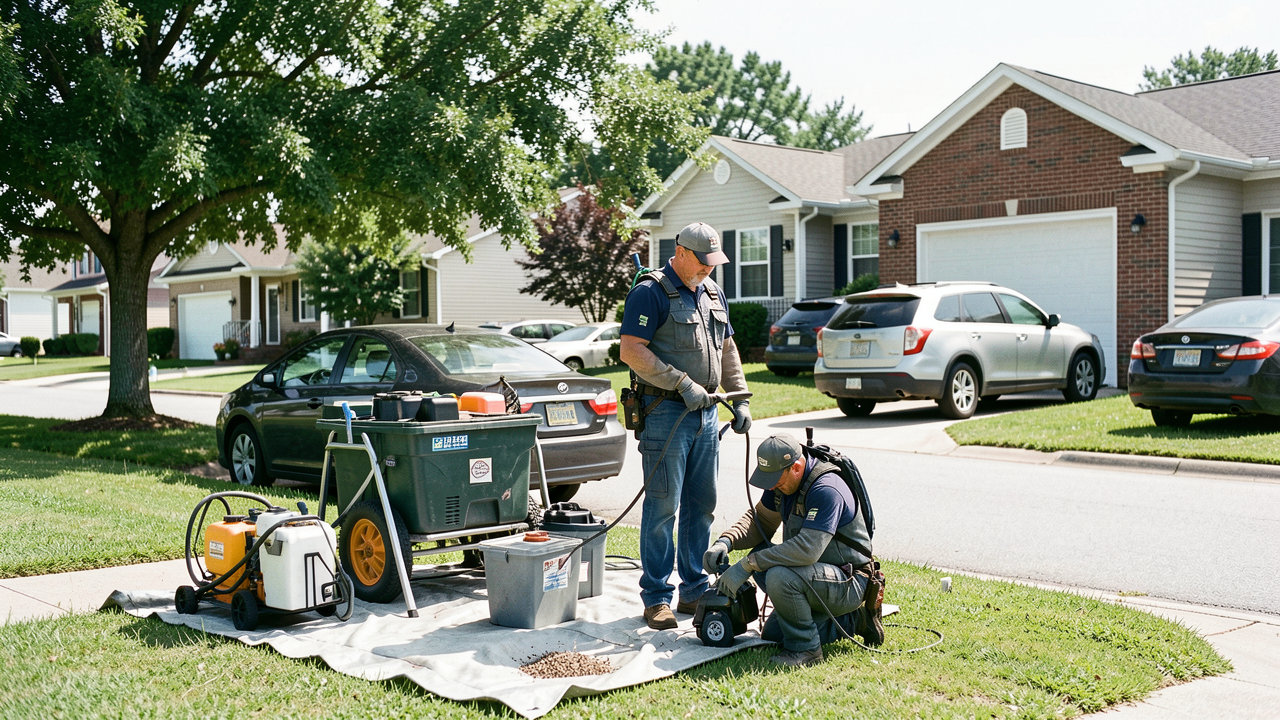
Drywood termites don't live in the soil. They nest inside the wood they're eating — a rafter, a window sill, a door jamb, a piece of antique furniture — and a colony can sit in a Slidell attic for years before anyone notices. That changes everything about how the problem is found and how it's treated, which is why a drywood job looks nothing like the trenching and rodding used against the subterranean kind.
The giveaway is frass: tiny, hard, six-sided pellets about the size of coarse coffee grounds, piled on a sill, a floor, or a shelf below a small round hole in the wood. Sweep the pile up and it comes back. You may also see blistered or rippled paint where galleries run just under the surface, or hear a faint rattling in a wall after dusk. What you will not see is mud tubing up a pier or a slab edge — that's subterranean work, and in this parish it usually means Formosan subterranean termites, an invasive species that does structural damage faster and resists control better than our native species. Plenty of homes here have both problems at once, which is exactly why the inspection has to settle the species before anyone quotes a treatment. Guess wrong and you spend money on the wrong method entirely.
Louisiana's humid subtropical climate means there's no real off-season. Swarmers from drywood colonies turn up on window ledges and in light fixtures in warm weather, but feeding carries on through winter. Finding frass in January is not a false alarm.
If the infestation is confined — one door frame, a short run of fascia, a piece of trim — it can often be handled in place by drilling small ports into the galleries and injecting foam, dust or a borate product, then patching. Accessible attic framing can be treated directly on the surface. Where it gets harder is finished wood: painted trim, tongue-and-groove ceilings, hardwood flooring, or framing buried behind sheetrock and insulation. Spot work only succeeds if the full extent of the galleries is known, and the common failure is treating the one hole you can see while two more pockets keep working in the same wall.
When kickout holes and frass show up in several separated areas, or in parts of the frame nobody can reach, whole-structure fumigation becomes the honest answer. That means tarping or sealing the building, a mandated vacancy period, bagging or removing food and medication, arranging for pets and plants, and someone taking responsibility for roof and landscaping protection. Ask who handles the prep, how the structure will be sealed, and what the plan is for the roof type you have.
Cost tracks the amount of wood involved, how much of it is accessible, and whether the job is localized or structure-wide — fumigation is priced on the cubic volume of the building, so roof pitch and attic height matter as much as floor area. Before you commit, ask how the species was confirmed, how many separate infestation points were found, and what happens if new frass appears after treatment.
Subterranean Barrier Co. covers Slidell, Lacombe and Alton, offers free estimates and can often get out the same day. Call to arrange an inspection and to go over accepted payment methods.