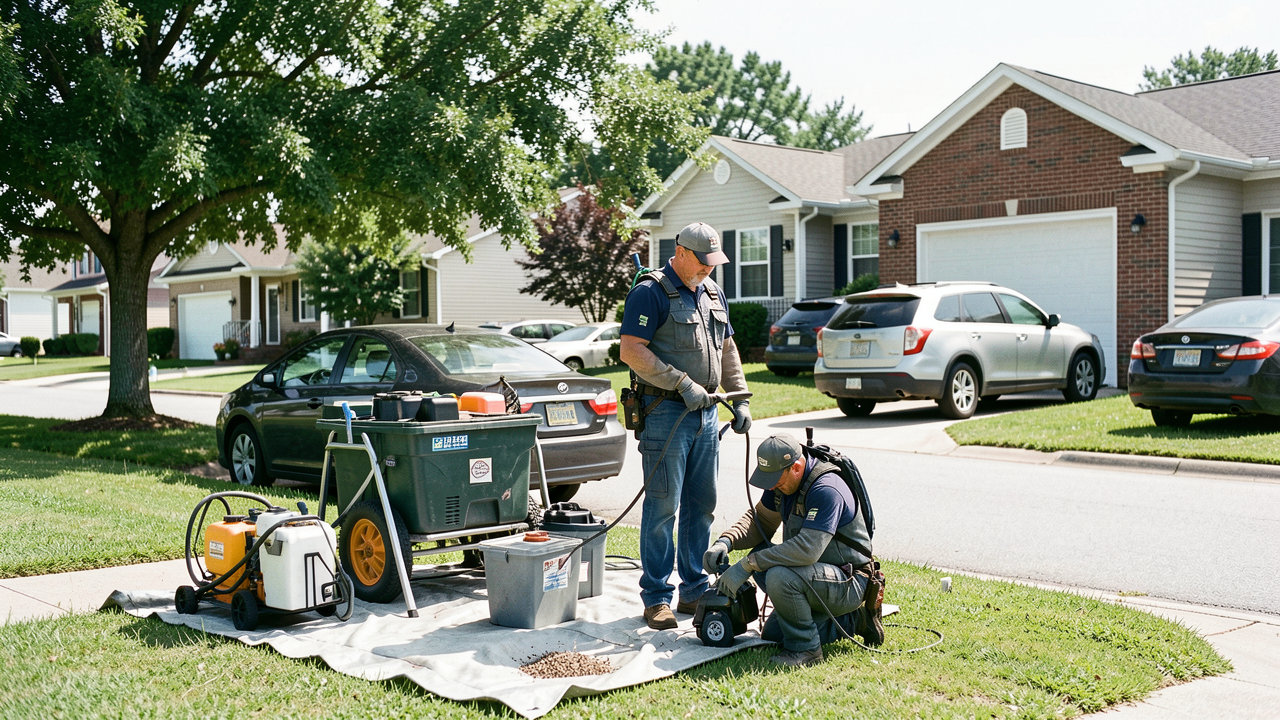
Liquid termite barrier treatment puts a continuous band of termiticide in the soil around and under your home, so that any subterranean colony tunnelling toward the structure has to pass through treated ground to reach it. It is the traditional answer to subterranean termites, and in this part of Louisiana it is still the answer most often used on slab homes, brick veneer and raised piers alike.
Louisiana has a severe, well-documented Formosan subterranean termite problem. These are not native termites — the colonies are far larger, they forage over a wider area, and they are considerably harder to knock back once they are established in a structure. Southeast Louisiana's humid subtropical climate also means there is no real winter pause; activity continues year-round rather than stopping cold in December. That changes two things for you. First, a swarm in spring is a symptom, not the start of the problem, and the absence of a swarm proves nothing. Second, a barrier with a gap in it is close to worthless, because Formosan foragers are very good at finding the gap.
A proper job starts with a measurement, not a quote off a phone call. The technician walks the perimeter, notes linear footage, identifies every point where soil contacts the structure, and finds the hard parts: attached garages, concrete porches and stoops, patios and driveways poured against the foundation, expansion joints, bath traps, utility penetrations, and any stucco or veneer that runs below grade.
Then the barrier goes in. Soil along the foundation is trenched — usually a narrow trench against the wall, down toward footing depth — and termiticide is applied at the dilution and volume the product label specifies per linear foot. Where concrete abuts the house, the slab is drilled at intervals and the solution injected beneath it, then the holes are patched. Hollow block voids may be rodded. The trench is backfilled with treated soil, not clean fill. Pier-and-beam homes add interior piers and chimney bases to the list. Done right, the treated zone is continuous; the common failures are skipping the drilling under a patio because it is awkward, treating only three sides of a house, or thinning the mix to stretch product.
Cost tracks linear footage first, then how much concrete has to be drilled, how much landscaping, decking or AC equipment has to be worked around, whether the home is slab or raised, and which termiticide is used — non-repellent products that termites cannot detect and carry back to the colony generally cost more than older repellent chemistries. An existing active infestation with damaged wood is a different conversation from a preventive barrier on a sound house.
Before you commit, ask what product is being applied and whether it is non-repellent, ask for the linear footage and the gallons that number requires, ask specifically how the porch, patio and bath traps will be handled, and ask what the treatment diagram will show. Ask what happens if you later pour a slab over treated soil, and whether an annual renewal and retreatment agreement is available.
Subterranean Barrier Co. covers Slidell, Lacombe and Alton, offers free estimates and same-day service, and can go over payment methods when you call. Enquiries are by phone.