Mud tubes the width of a pencil running up a pier or a slab edge, a hollow sound when you tap a door frame, or a pile of discarded wings on a windowsill after a warm evening — those are usually how subterranean termites announce themselves. By then the colony has been working for a while. Subterranean species nest in soil and travel up through cracks, expansion joints, plumbing penetrations and bath traps, so most of the damage happens inside wall voids where you cannot see it until something sags or a paint surface blisters.
Louisiana has a well-documented and severe problem with Formosan subterranean termites, an invasive species that builds far larger colonies than our native termites, damages structures faster, and is considerably harder to knock out. Add the humid subtropical climate of southeast Louisiana, which keeps termites and other structural pests active year-round rather than giving you a true winter pause, and there is no safe season to put an inspection off. Spring and early summer swarms are the most visible sign, but feeding never really stops.
It starts with an inspection: the perimeter, the slab edge or crawl space, the sill plate, the attic where accessible, and anywhere water sits — hose bibs, AC condensate lines, downspouts that dump against the foundation. The point is to find where they are getting in and how much wood has already gone.
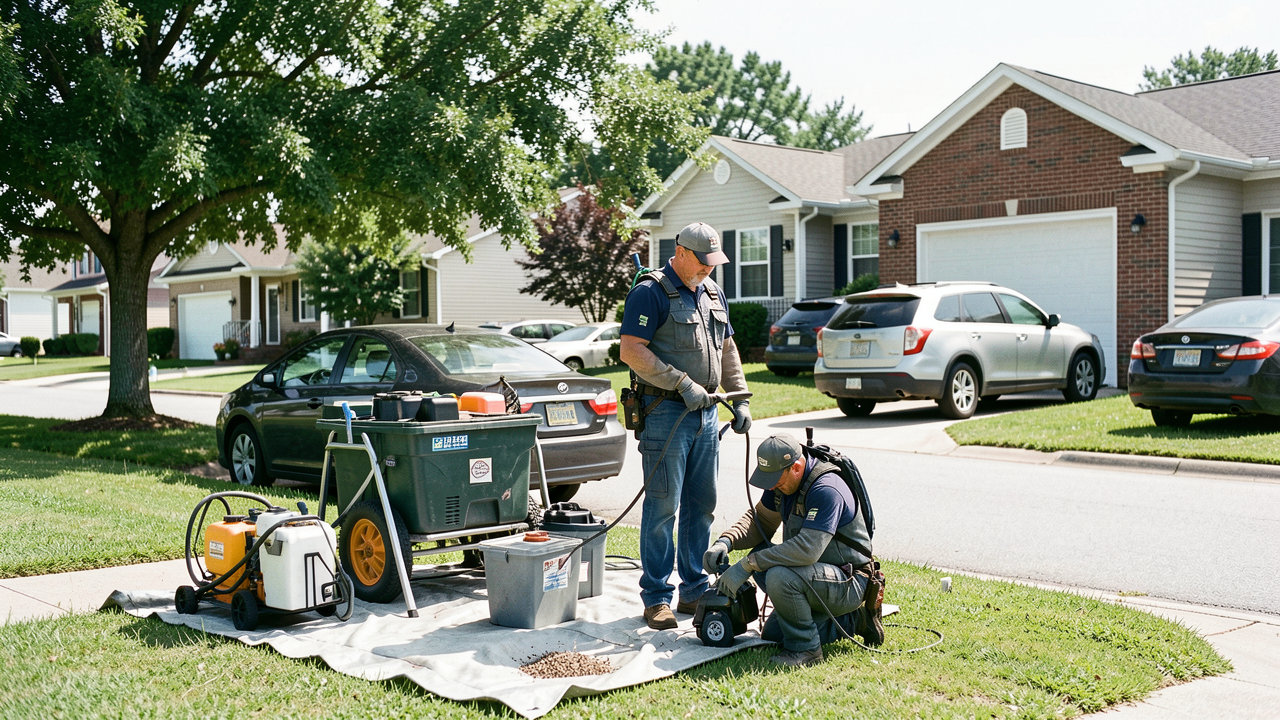
A conventional liquid barrier means trenching the soil around the foundation to a consistent depth, rodding the trench so the termiticide reaches below grade, and treating back into the soil as it is replaced. Where a driveway, patio or garage slab abuts the house, that concrete is drilled at intervals and injected, then the holes are patched. Bath traps and plumbing penetrations are treated separately because that is a classic entry point in slab-on-grade houses. The alternative approach is an in-ground baiting system — stations placed around the structure, monitored and recharged on a schedule, which eliminates the colony over time rather than putting up an immediate chemical wall. Many Slidell homes end up with a combination, particularly where a slab is cracked, a porch is poured against siding, or soil grade sits too high on the foundation wall.
Linear footage around the structure is the baseline, but the variables matter more: slab versus pier-and-beam, how much concrete has to be drilled, whether there is a crawl space someone can physically get into, attached structures like garages and additions, and whether the job is a preventive barrier or a response to active infestation with damaged members that need a carpenter afterward. Shallow water tables and heavy clay soils in this area also affect how a liquid application is placed.
Ask any company for a written diagram of where product will go, the product name and label rate, how slab penetrations will be sealed, and whether what you are buying is renewable, inspected annually, or a one-time application. A barrier with a gap at the back porch is not a barrier.
Subterranean Barrier Co. covers Slidell, Lacombe and Alton, offers free estimates and same-day service, and takes a range of payment methods. Call to get an inspection scheduled — phone is the way to reach us.