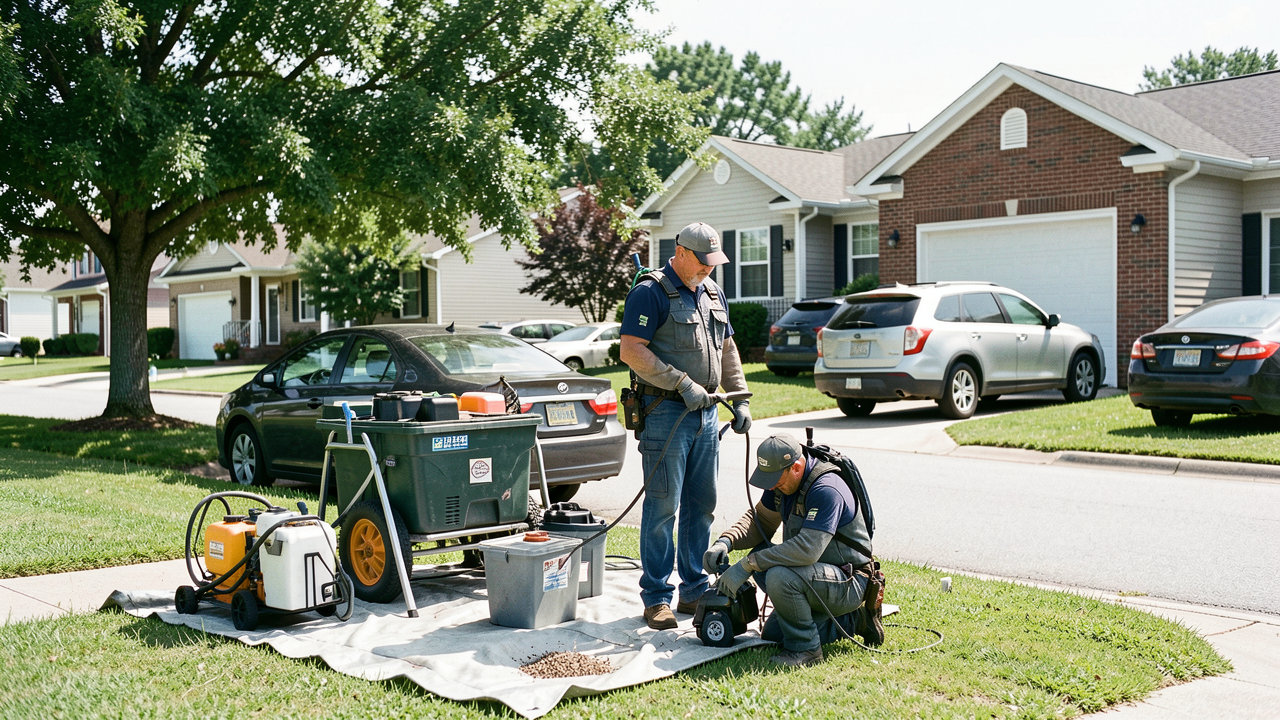
Getting a pre-treat right means being on site at the one narrow window where it can be done at all — after the plumbing is in and the pad is graded, before the vapor barrier goes down and the trucks arrive. Miss that window and you are no longer doing a pre-treat. You are doing a post-construction treatment on a finished slab, which costs more, works around what has already been built, and never quite matches a barrier laid into clean soil.
On a typical slab job, the soil under the footprint is treated at the rate the product label calls for, with particular attention to the places termites actually use: around every plumbing and conduit penetration, along the footing trenches, around interior grade beams, and at any expansion joint or cold joint where the slab will later crack or separate. The point is a continuous treated zone with no gaps, because termites only need one. On pier-and-beam or raised foundations the approach shifts to trenching and treating the soil around piers and perimeter, and some builders add a borate application to the framing lumber once it is up, which is a separate step and a separate line item.
After the slab is poured and the house is framed, the backfill against the foundation gets disturbed by every trade that comes through — trenching for utilities, grading, landscaping. A final exterior perimeter treatment once the grade is set is what closes that out. If the builder's schedule calls for it, that is worth confirming up front rather than discovering at closing that only the under-slab portion was done.
Louisiana has a well-documented, severe Formosan subterranean termite problem. Formosans build larger colonies than native subterranean termites, are harder to control once established, and do structural damage faster. On top of that, the humid subtropical climate across St. Tammany Parish means termites stay active year-round — there is no winter pause that gives a new house a grace period. A slab poured in January in Slidell is exposed on the same timeline as one poured in July.
Local soil conditions matter too. Plenty of lots around Lacombe and Alton are built on brought-in fill with a high water table underneath. Heavy rain between the treatment and the pour can move product out of position, and a reputable applicator will tell you when a retreatment is needed rather than letting it slide.
Call as soon as your plumbing rough-in is scheduled, not the day before the pour. Pour dates move; same-day service is available when a schedule shifts suddenly, but notice makes it easier on everyone. Estimates are free, and what drives the number is square footage of the slab, linear footage of footing and perimeter, foundation type, whether borate wood treatment is included, and how many return trips the build requires.
Ask any applicator for documentation of what was treated and when — lenders and buyers frequently want to see it, and it is easier to get at the time of application than to reconstruct later. Subterranean Barrier Co. takes enquiries by phone; call to go over your build schedule and get a figure for the job.