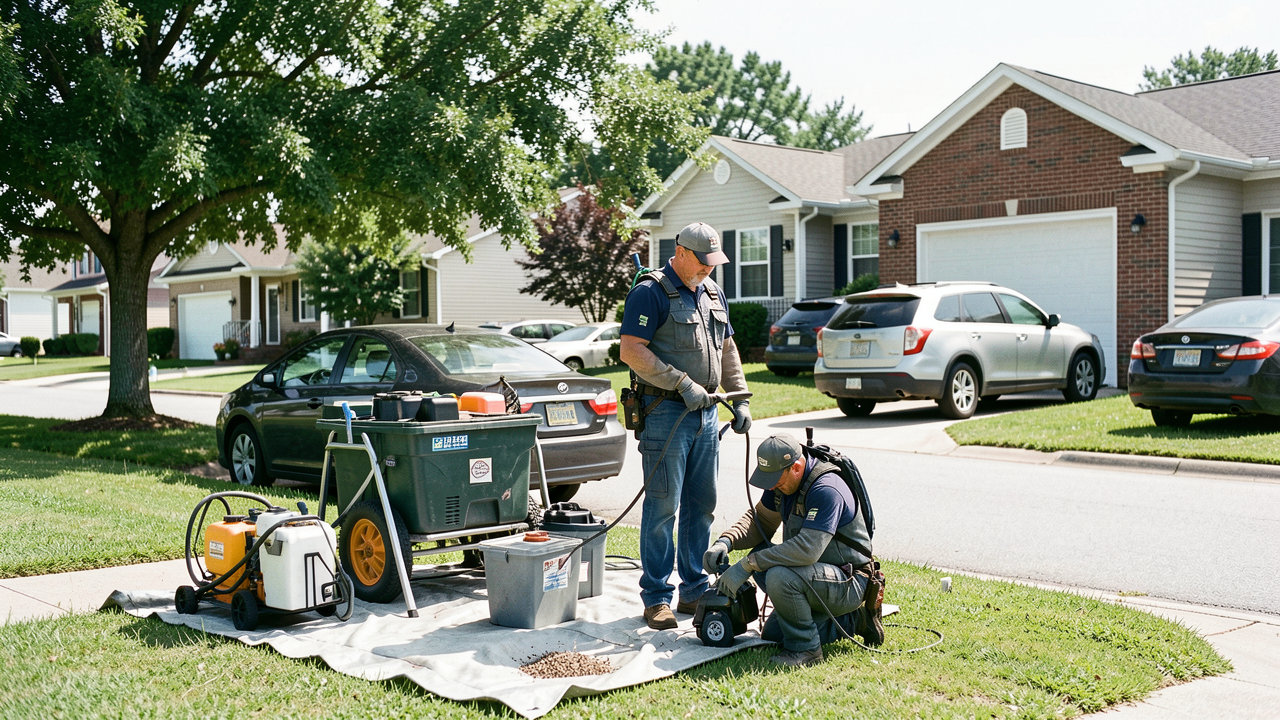
A soil treatment puts a continuous band of termiticide in the ground around and under your house, so that subterranean termites moving up from the soil hit treated earth before they reach wood. It is the standard defence for slab homes in this part of Louisiana, and it matters more here than in most of the country: Formosan subterranean termites are well established across southeast Louisiana, they build far larger colonies than native species, and they are harder to knock back once they are inside a structure. The humid subtropical climate also means there is no real winter pause — foraging continues year-round, so there is no off-season in which an untreated house is safe.
On a slab-on-grade house, the crew digs a narrow trench against the foundation, usually six inches or so deep and a few inches wide, and applies a measured volume of diluted termiticide per linear foot along it, then rods the soil below the trench where needed before backfilling with treated dirt. Where concrete abuts the house — driveways, patios, porches, carports, garage slabs — the soil underneath has to be reached by drilling small holes through the concrete at intervals and injecting beneath, then patching. Bath traps, plumbing penetrations and expansion joints get specific attention, because those are the gaps termites exploit most often in a slab house. On a raised or pier-and-beam home, the work extends to the interior piers and the perimeter beam under the crawl space.
The two things that determine whether a barrier works are continuity and volume. A gap of a few feet where a flower bed or an AC pad got skipped is a doorway. Short-filling the label rate — putting down less solution than the product requires per foot — leaves thin spots that look identical from above and fail quietly a year or two later. Ask what product is being used, what rate it is applied at, and how many gallons the job should take. A contractor who knows the answer will tell you without hesitating.
Linear footage of foundation is the baseline. After that, it is how much concrete has to be drilled, whether there is a crawl space and how accessible it is, how much landscaping, decking or AC equipment sits tight against the house, and the soil itself — the heavy clay and high water tables common around Slidell and Lacombe affect how product moves and how much rodding is required. Pre-construction treatment on a bare pad is the cheapest version of this work and the most thorough; retreating a finished house with a wraparound patio is the most involved.
Worth knowing: any later excavation against the house breaks the barrier. New French drains, re-grading, a replaced walkway, or a landscaper trenching for irrigation can all cut a treated zone open, and that section needs retreating.
Estimates are free, and in many cases the work can be scheduled same day. Before anyone starts, ask for a diagram showing the treated area and the penetrations addressed, ask who patches the drill holes and how, and ask what the ongoing inspection arrangement looks like once the barrier is down — a termiticide in soil is a defence, not a permanent fix, and annual checks are how you catch a breach early.
Call to arrange an estimate for your property in Slidell, Lacombe or Alton, and ask about accepted payment methods when you do.