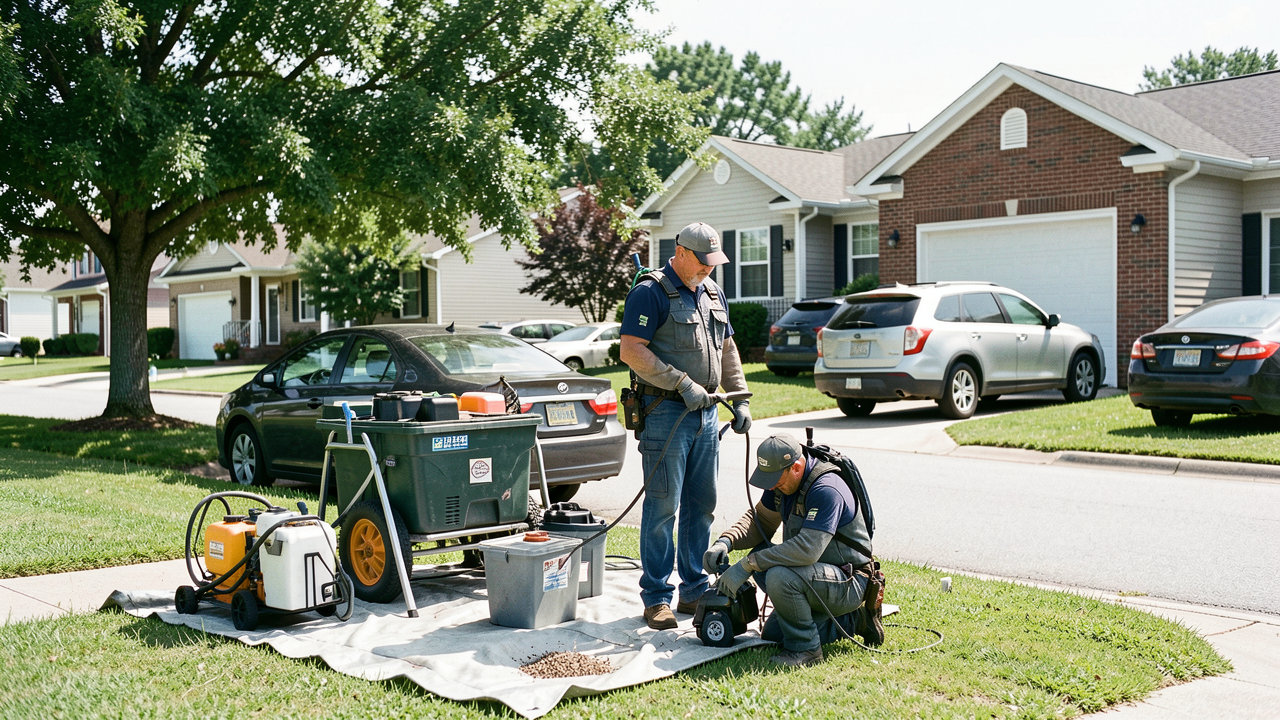
Houses in Slidell don't get a winter break from bugs. The humid subtropical climate across southeast Louisiana keeps termites, roaches and ants active year-round rather than shutting them down for a few cold months, which is why a one-time spray in April rarely holds through August. Residential pest control here is maintenance work: a treated perimeter, monitored interior harborage points, and someone who knows which pest you actually have before anything gets applied.
The phrase "general pest control" covers a lot of ground, and the species decides the method. German roaches breed indoors, live in kitchen and bathroom voids, and respond to gel baiting and growth regulators — spraying baseboards mostly scatters them deeper into the wall. Smoky brown and American roaches come in from outside through weep holes, soffits and sewer lines, so that job is a perimeter and exclusion job, not an interior one. Fire ants are a yard problem: mound treatment alone just moves the colony, so broadcast bait across the turf is usually what actually reduces them, and it takes weeks to show. Carpenter ants are a moisture and wood problem — finding them means finding the damp fascia board, the leaking window frame or the stacked firewood against the house, and treating the nest rather than the trail. Rodents aren't a spray job at all; that's sealing entry points, trapping, and removing what's attracted them in the first place.
Termites sit in their own category, and in this part of Louisiana they are the pest worth taking seriously. The state has a well-documented, severe problem with Formosan subterranean termites — an invasive species that builds far larger colonies than natives, attacks structural timber aggressively, and is considerably harder to control once established. Mud tubes on a slab edge or pier, discarded wings on a windowsill after a spring swarm, or wood that sounds hollow under a screwdriver all warrant an inspection rather than a general treatment. Termite work means a liquid soil barrier or a monitored baiting system, and it is a different scope from the pest management plan that handles roaches and ants.
A proper first visit starts outside. Weep holes, foundation cracks, utility penetrations, door sweeps, the gap where the dryer vent meets the siding — these are where bug control is actually won. Treatment goes around the perimeter, into cracks and crevices, under eaves where mud daubers and spiders build, and around the foundation. Inside, the focus is targeted: under sinks, behind appliances, in the attic access, in the garage and utility room. Baits get placed where you won't disturb them. You should expect to be told what was found and where, not just that the house was "treated."
Older homes around Slidell and the raised houses closer to the water in Lacombe bring their own issues — crawl spaces that hold moisture, subfloor access that's tight or partially blocked, and slab homes where a cracked slab gives ants and roaches a direct route inside. After heavy rain, fire ants surface and roaches push indoors, which is why call volume jumps in the days following a storm. Same-day service is available when something has already gotten into the house and you don't want to wait on it.
What varies the cost: square footage and number of stories, how much of the perimeter is accessible, whether the yard is included for fire ants or mosquitoes, whether rodent exclusion work is needed, and how severe the infestation already is. A quarterly pest management plan generally costs less per visit than repeated one-off calls, because the perimeter stays intact. Estimates are free, so getting one costs you nothing but a phone call.
Before you hire any exterminator, ask what product class is being used and how long it needs to stay dry, whether pets and children need to be out and for how long, whether follow-up visits are included in the price if something comes back between services, and — for roaches or ants — what the plan is for the nest, not just the ones you can see. Pest removal that only kills visible insects leaves the colony working. Ask for the inspection findings in writing or in detail verbally, and get the retreatment terms clear up front. Subterranean Barrier Co. takes enquiries for Slidell, Lacombe and Alton by phone, with several payment methods accepted at the time of service.