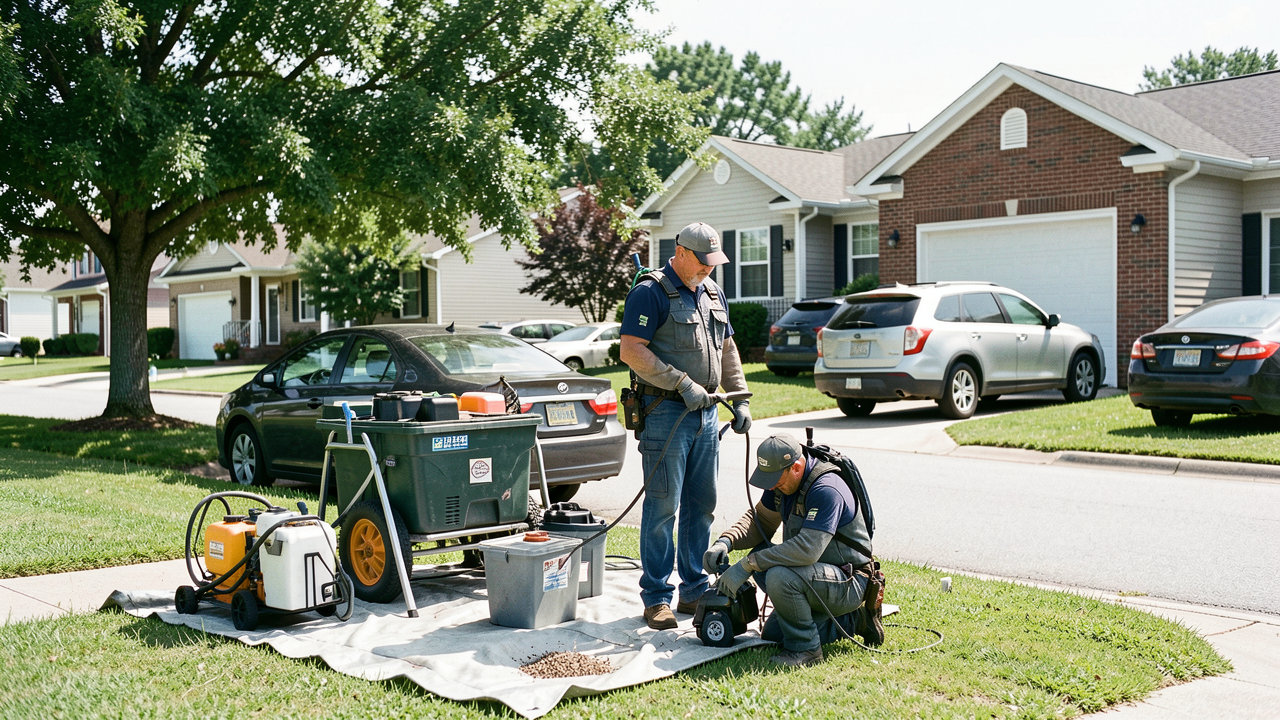
Pre-construction termite treatment has a short window. It happens after the final grade and plumbing rough-in, and before the vapor barrier and concrete go down. Miss that window and you lose the only chance you will ever have to put termiticide directly under the slab. Everything after that is perimeter work around the outside of a finished building, which is useful but not the same thing.
The soil treatment is applied in two parts. The horizontal portion covers the full footprint of the slab — the pad, the fill, and particularly the critical zones around plumbing penetrations, the bath trap opening, and any utility sleeves coming up through the pour. The vertical portion treats the soil against the footing and along the inside of foundation walls and grade beams, so termites coming up from below cannot simply run the face of the concrete. After backfill, a second application around the exterior perimeter completes the barrier, because the dirt pushed back against the foundation is untreated soil sitting right where you least want it.
Rate matters more than product brand. Termiticides are labeled for a specific volume per square foot of slab area and per linear foot of trench, and a treatment applied thin is a treatment that will not hold. In Slidell, where most lots get trucked-in fill and the water table sits high, that soil can also shed chemical quickly if a hard rain lands before the pour. If the slab gets delayed more than a day or two after treatment, or if a trade comes back through and trenches the pad for a late plumbing change, that section needs retreating. Ask about that up front rather than discovering it after the concrete truck leaves.
This part of Louisiana deals with Formosan subterranean termites, an introduced species that builds far larger colonies than native termites and does structural damage faster and more quietly. The humid subtropical climate here means they stay active year-round rather than shutting down over winter, so a new build in Lacombe or Alton has no dormant season to coast through while the barrier waits.
Slab square footage and the linear footage of footing and foundation wall are the main drivers. Beyond that: whether the home is slab-on-grade or raised, how many separate pours are involved, whether the garage and porches are monolithic or poured later, how accessible the pad is to equipment, and whether you want borate wood treatment on framing as a second layer once the structure is dried in. Return trips to retreat disturbed soil can factor in too, depending on how the job is set up. Estimates are free, so it costs nothing to get real numbers against your build schedule.
Ask what product is being used and at what rate for your square footage. Ask who comes back if the pour slips or the pad gets cut. Ask for the treatment documentation in writing — your builder, inspector or lender will likely want proof the soil was treated, and it is far easier to get it at the time than to reconstruct it later. Ask whether the treatment can be carried into an ongoing contract once the house is finished.
Call to get on the schedule, including same-day when your pour date moves. Several payment methods are accepted.