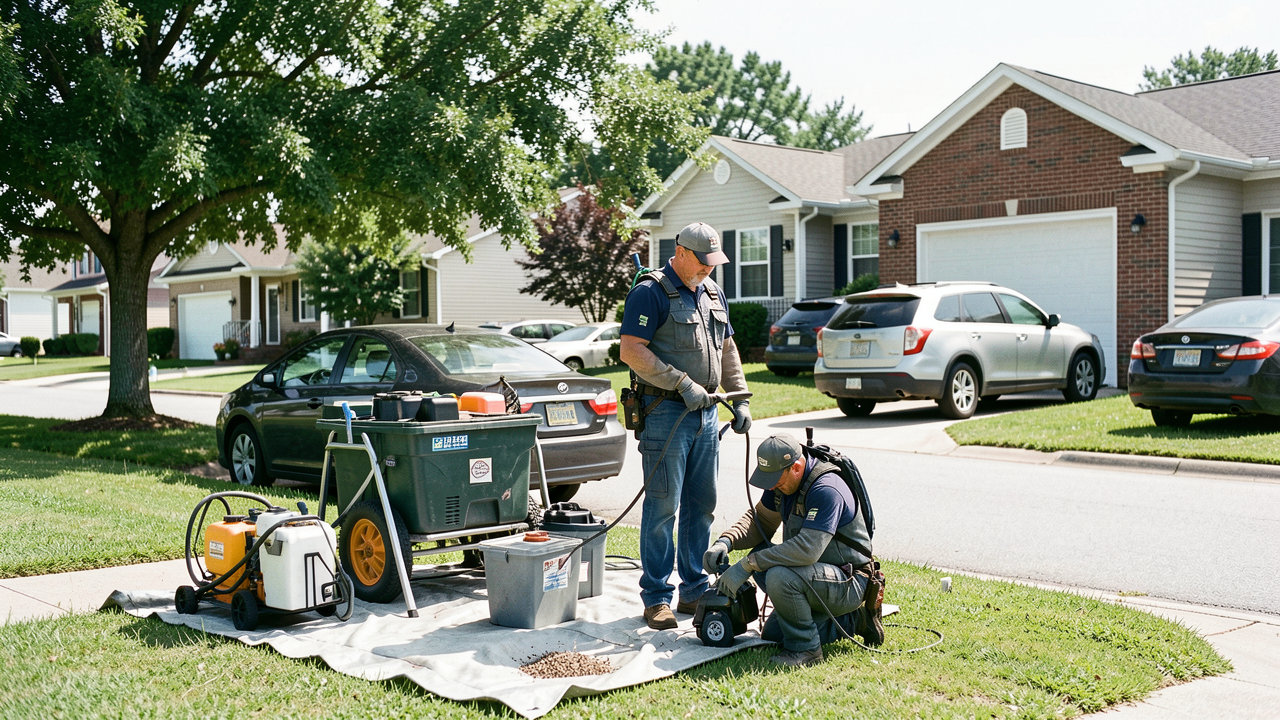
Termites in St. Tammany Parish do not wait for a convenient month. Southeast Louisiana's humid subtropical climate keeps subterranean termites, roaches, and rodents active year-round rather than shutting them down over winter, and the Formosan subterranean termite — an invasive species that has done well-documented structural damage across Louisiana — builds bigger colonies and is harder to knock back than the native species. That is the backdrop to every inspection in Slidell, whether you are buying a house on a slab off Gause, selling a raised place in Lacombe, or just noticed something you did not like in the garage.
An inspection is a search for evidence, in a deliberate order. Outside, the work starts at ground level: the foundation perimeter, where soil or mulch is piled against siding, where a slab is hidden behind a flowerbed, where a porch slab or stoop abuts the house and gives termites a covered route up. Mud tubes on piers and block, hollow-sounding or soft trim probed with a screwdriver, moisture staining on skirt boards, wood fence posts and old landscape timbers in contact with soil, and any debris or stored lumber under a raised house all get looked at. Soffits, fascia and window sills are checked from the ground and from the ladder where there is reason to.
Inside, the sequence runs to the places water and wood meet. Bath traps — the open soil void under a tub in slab construction — are a classic entry point and a classic thing a rushed inspector skips. Plumbing and pipe penetrations, water heater closets, the base of door jambs, baseboards along exterior walls, garage framing where it meets the slab, and the attic with its sheathing and rafters all get inspected. Discarded wings on sills, pinholes with a sand-grain texture of spoil around them, frass under beams, or the papery blistered look of a painted surface over eaten wood are what give an active infestation away. Carpenter ants leave a different signature — clean galleries, coarse sawdust-like frass kicked out of a slit rather than mud-packed tunnels — and they almost always point back to a moisture problem such as a leaking flashing or a chronically damp sill. Fire ants are a yard and safety issue rather than a structural one, treated differently and priced differently, so if mounds are what prompted the call, say so on the phone and the visit can be aimed accordingly.
A home pest inspection for buyers or sellers is a narrower, more formal job than a diagnostic visit. Lenders and closing attorneys commonly require a wood-destroying insect report before funding, and that report states what was visible on the day, what areas were inaccessible, whether there is evidence of active infestation, and whether there is evidence of previous treatment or previous damage. Those last two matter enormously around here. Plenty of Slidell and Lacombe houses have been treated at some point, and a lot were rebuilt or repaired after flooding, so old damage with no live colony is common — and a report that does not separate old from active either kills a sale that should have closed or hands a buyer a surprise.
If you are selling, book the inspection early enough that there is room to treat and re-inspect before the closing date rather than the week of it. If you are buying, ask who the report is issued to, whether obstructed areas will be noted in writing, and whether the inspector will tell you what they could not see — a report with no limitations listed on a furnished, fully finished house is not thorough, it is incomplete.
Price tracks size, construction and access more than anything else. A compact slab home with a clear perimeter is quicker than a raised house in Lacombe with a tight crawlspace, or a property with an attached garage, workshop and outbuildings that all need covering. A report prepared for a real estate transaction involves documentation a straightforward diagnostic call does not. Estimates are free, and same-day inspections are available when the schedule allows, which helps when a closing date is bearing down. Several payment methods are accepted — ask when you call.
Before the visit, clear access to the attic hatch, the water heater closet and the garage walls, and pull stored boxes back from exterior walls. Calls are taken by phone for Slidell, Lacombe and Alton, and it helps to describe what you saw and where, because wings on a windowsill and sawdust under a porch beam send the inspection in two different directions.