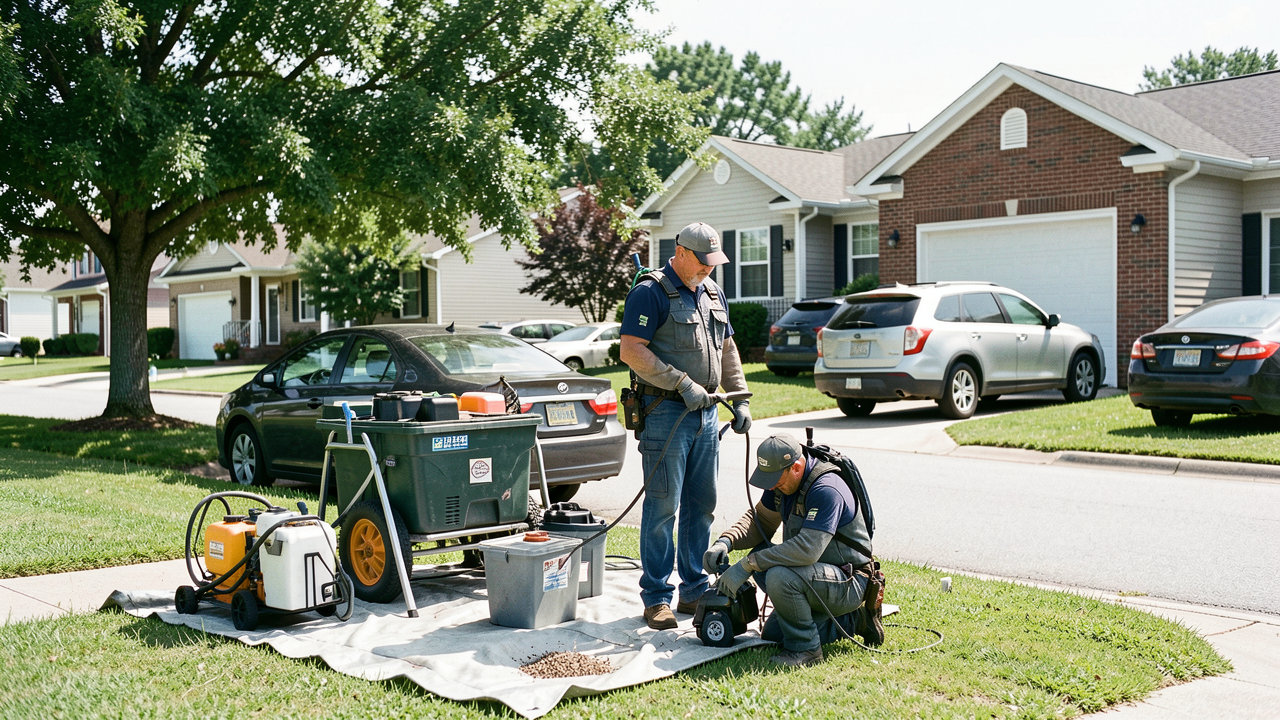
Exclusion is the part of pest control that doesn't wear off. A treatment knocks down what's already inside; exclusion changes the reasons they keep coming back. On older Slidell houses, that usually means a few dozen small openings nobody has looked at since the roof was last replaced — and in a parish where humid subtropical weather keeps roaches, ants and rodents active through the winter instead of pausing for a cold season, those openings are working for the pests twelve months a year.
The job starts outside, low, and works up. At ground level: garage door bottom seals that have hardened and curled at the corners, weep holes in brick veneer wide enough for a mouse, utility and A/C line penetrations stuffed with nothing but a squirt of old caulk, hose bib and dryer vent gaps, and crawlspace vents with rusted-through screen. On raised houses around Lacombe and the bayou-side lots, the underside is its own project — torn vapor barrier, open pier skirting, ductwork with daylight showing at the joints. Up top: soffit-to-fascia gaps at the roof returns, lifted drip edge, ridge vent that storms have unseated, gable vents with no screen behind the louvers, and plumbing boots that have cracked in the sun. Rodents need about a quarter inch and will widen what they find; roaches and ants need far less, which is why sealing for mice alone leaves half the problem in place.
Materials matter more than effort here. Spray foam alone is not exclusion — rodents chew straight through it and it hides the gap from the next person who looks. Proper work uses rigid materials where the gap is structural (sheet metal flashing, hardware cloth, mortar at the brick line), copper or stainless mesh packed into irregular voids, and sealant only as the finish over something a tooth can't get through. Vents get screened, not blocked, because closing off a crawlspace or attic vent to stop pests creates a moisture problem that costs far more than the pests did. Where wood has already gone soft at a soffit corner or a door jamb bottom, sealing over rot is a waste; that board gets called out so it can be replaced before the seal goes on.
Sealing handles the gaps you can reach. An exterior perimeter pest barrier handles the traffic before it gets there — a residual application banded along the foundation and up the lower wall, carried into weep holes, around door thresholds and window frames, under the lip of the slab, and out a short distance into the soil and mulch line. It's what stops the seasonal pushes: smokybrown roaches moving off the live oaks after rain, millipedes and crickets crowding the slab in wet weeks, the ant trails that find a kitchen in three days. Rainfall and irrigation shorten its life, so around here it's a repeating service rather than a one-off, and the interval depends on exposure more than the calendar.
Not all ants get the same treatment, and that's worth asking about before you book. Fire ants are a soil and mound problem — they're worked with baits and mound drenches across the yard, because a wall spray does nothing to a colony living thirty feet out in the turf. Carpenter ants are a moisture and wood problem — finding them means tracing back to the damp sill, the leaking window, the dead limb against the roof, and the treatment follows the nest rather than the trail. And exclusion does not stop subterranean termites, Formosan or otherwise. Louisiana's Formosan problem is severe and well documented, and those colonies come up through the soil and into the structure in ways no caulk gun addresses; that's a separate treated-soil or bait-station job, and anyone telling you a perimeter spray covers it is selling you the wrong thing.
On the phone, ask what gets sealed versus screened, what the material is at each point, whether the crawlspace and attic are included or quoted separately, and what the reapplication schedule looks like for the exterior barrier. Price moves with the size of the footprint, the height and reach of the roofline, whether the house is slab or raised, how much rotted trim has to be dealt with first, and how much of the work needs a ladder or a crawl. Subterranean Barrier Co. gives free estimates and can often get out the same day in Slidell, Lacombe and Alton, with several payment methods accepted. Call to get the walkaround booked — the quote comes off what's actually found on the house, not off a square-foot guess over the phone.