Commercial termite protection starts with a full graph of the structure — perimeter measured in linear feet, slab type identified, every plumbing penetration, expansion joint, utility chase and attached stoop noted. On a strip center or warehouse that graph matters more than anything that happens afterward, because termites don't enter through the middle of a slab. They come up through cracks, cold joints where an addition meets the original pour, and the gaps around pipes. Any treatment that ignores those is a treatment with holes in it.
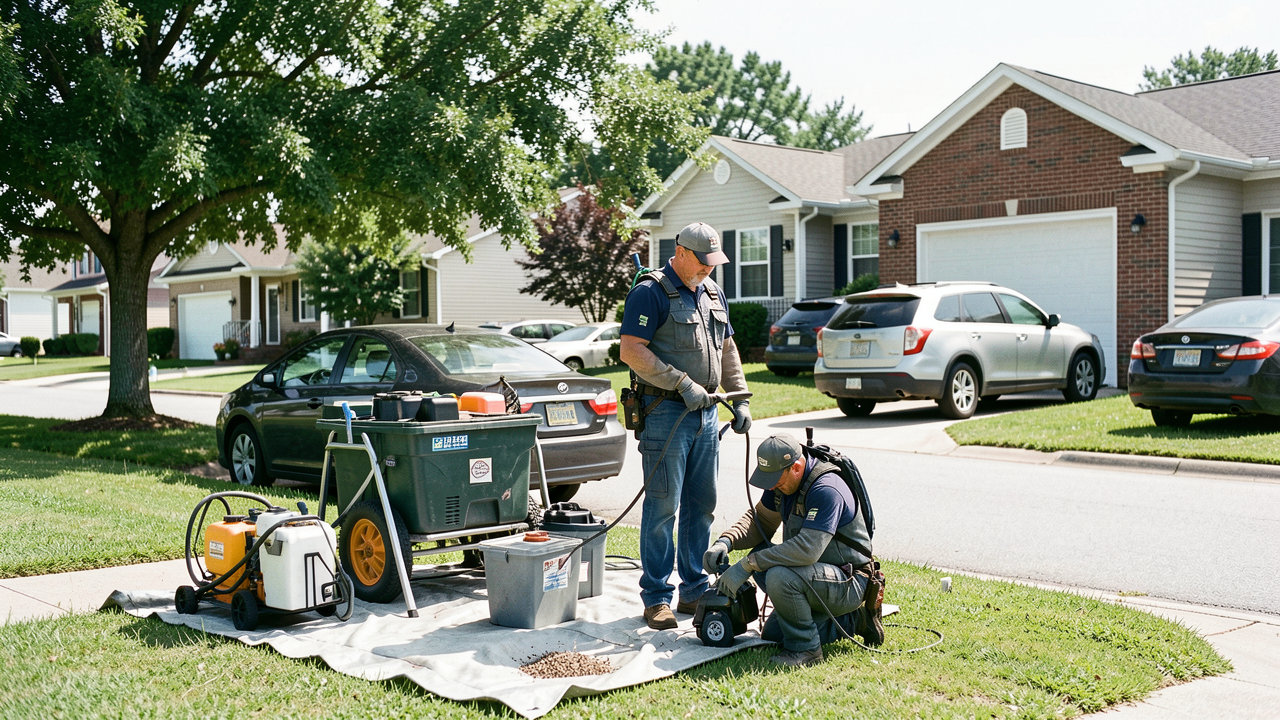
The liquid side of the job is trenching the soil against the foundation, rodding below the trench line where fill is deep, and drilling through concrete aprons, sidewalks and interior slab areas that block access. Drill holes go in at close spacing, termiticide goes in at label volume, and holes get patched. On buildings where drilling through a finished floor isn't practical — a restaurant dining room, a pharmacy sales floor — in-ground bait stations around the perimeter are often the better fit, with the trade-off that baiting works on a monitoring cycle rather than giving you a barrier on day one. Many commercial jobs end up using both, liquid where it can be applied and bait where it can't.
Louisiana has a severe, long-documented Formosan subterranean termite problem. Formosans build larger colonies than native subterranean termites, forage over a wider area, and are harder to knock down once established — which is why a treatment that would hold on a different stretch of Gulf Coast can fail here. The humid subtropical climate across St. Tammany Parish also means there's no real winter pause. Activity continues year-round, so a building left unprotected between contracts isn't sitting idle for a season; it's exposed the whole time.
For commercial property, the damage is rarely just structural. A restaurant with a swarm in the dining room on a Friday evening loses the night. A tenant who finds mud tubes on an interior partition starts asking the landlord questions. That's why most commercial agreements are written as ongoing coverage with scheduled reinspection, not a one-time application.
Cost on commercial work tracks linear footage of perimeter, how much concrete has to be drilled, whether the slab is monolithic or has multiple pours, how many separate structures are on the parcel, and how much access is blocked by landscaping, loading docks or mechanical equipment. A tilt-wall warehouse with a clean perimeter costs less per foot than a 1970s strip center with four additions and a covered walkway. Previous treatment history and visible active infestation also change scope, since active damage means treatment plus follow-up inspection rather than prevention alone.
Before you sign anything, ask what product is being used and at what rate, how expansion joints and plumbing penetrations will be handled specifically, how often bait stations get serviced and whether you receive a written record each visit, and whether the agreement covers retreatment only or retreatment plus damage repair. Ask who holds the agreement if a tenant changes. Get the inspection graph in writing.
Subterranean Barrier Co. works commercial properties in Slidell, Lacombe and Alton, offers free estimates, can often schedule same-day, and accepts multiple payment methods. Call to arrange an inspection — mention your building type, approximate square footage and whether you've seen swarmers or mud tubes, since that determines how long the inspection takes.