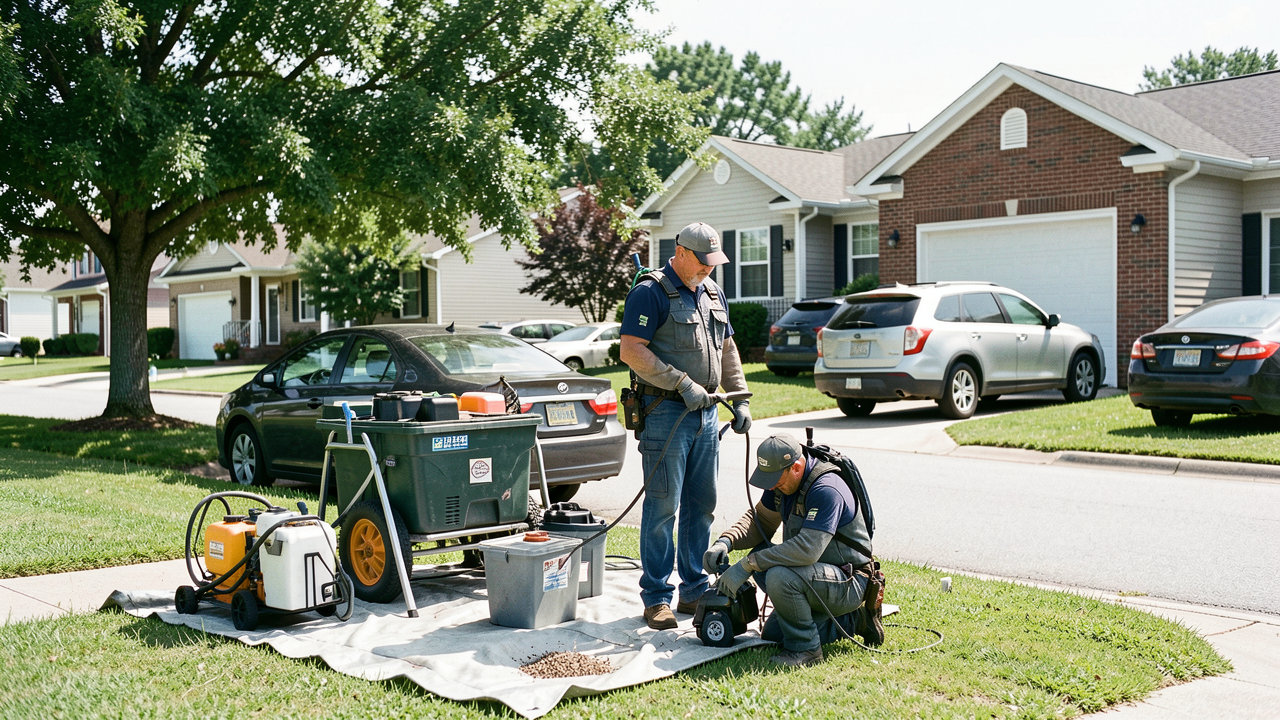
Two very different problems get called a roach problem in Slidell, and they do not get the same treatment. Knowing which one you have before you pick up the phone will save you money and save you a wasted visit.
If the roach you're seeing is large — an inch and a half or more, reddish-brown or dark with a glossy shell — and it turns up one or two at a time in the bathroom, the garage, or dead on its back in the hallway, you are almost certainly dealing with American or smokybrown cockroaches. Around here people call them palmetto bugs. They breed outdoors, in mulch beds, leaf litter, wood piles, tree holes, storm drains and sewer lines, and they come inside through gaps that have opened up over time: a dried-out weatherstrip, a slab crack, an unsealed plumbing penetration under the kitchen sink, a soffit vent, a broken sewer clean-out cap. Roach control for these is mostly exterior work — a treated band around the foundation, attention to the mulch and ground cover against the house, bait placed where they harbour, and sealing or flagging the entry points so they stop coming back in.
If instead the roaches are small, about half an inch, tan with two dark stripes behind the head, and you are seeing them in daylight on the counter, around the coffee maker, inside the microwave handle, or running out of a cabinet when you open it, that is a German cockroach and it is a completely different job. German cockroaches live their entire lives indoors, concentrated in kitchens and bathrooms, and a single egg case carries dozens of young. They arrive in grocery bags, second-hand appliances, moving boxes, and through shared walls in apartments and duplexes. The worst thing you can do is hit them with an over-the-counter aerosol: it scatters the population into wall voids and adjacent rooms and makes the infestation harder and more expensive to finish.
Proper German cockroach treatment is bait-driven, not spray-driven. That means gel bait placed in dozens of small, precise spots — hinge corners of cabinets, under the lip of the counter, behind the fridge motor, the void under the dishwasher, around pipe chases — plus a growth regulator so the juveniles that are already out there never reach breeding age. Monitors go down so there's a real measure of whether numbers are falling. It takes more than one visit. Two to four, spaced a couple of weeks apart, is normal, and a company that promises to clear a heavy kitchen infestation in a single trip is either going to disappoint you or going to spray in a way that makes things worse.
Your part matters here more than with any other pest. Bait competes with food, so crumbs under the toaster, grease behind the range, pet food left down overnight and a wet sink at bedtime all slow the job down. Cardboard storage, loose cabinet liners and a cluttered pantry give them harbourage. Expect to be asked to clear under the sink and pull the lower cabinet contents before the first visit.
Price turns on the size of the structure, how many rooms are involved, whether the problem is exterior pressure or an established indoor breeding population, and whether you need follow-up visits. A perimeter treatment on a single-storey home in Lacombe is a smaller job than clearing German cockroaches from a kitchen, a bathroom and a shared wall. Subterranean Barrier Co. provides free estimates, so get the specifics before you commit, and ask three things: what is being used and where, how many visits are included, and what happens if roaches are still showing up after the last one.
Southeast Louisiana's humidity and mild winters mean roaches stay active year-round here rather than dying back seasonally, so a one-off treatment in a house with ongoing exterior pressure — heavy mulch, a damp crawl space, mature oaks, an older sewer line — will need maintenance rather than a single fix. Same-day service is available for Slidell, Lacombe and Alton, and several payment methods are accepted. Calling is the only way to book; have a description of the roach, where you're seeing it, and what time of day it appears.