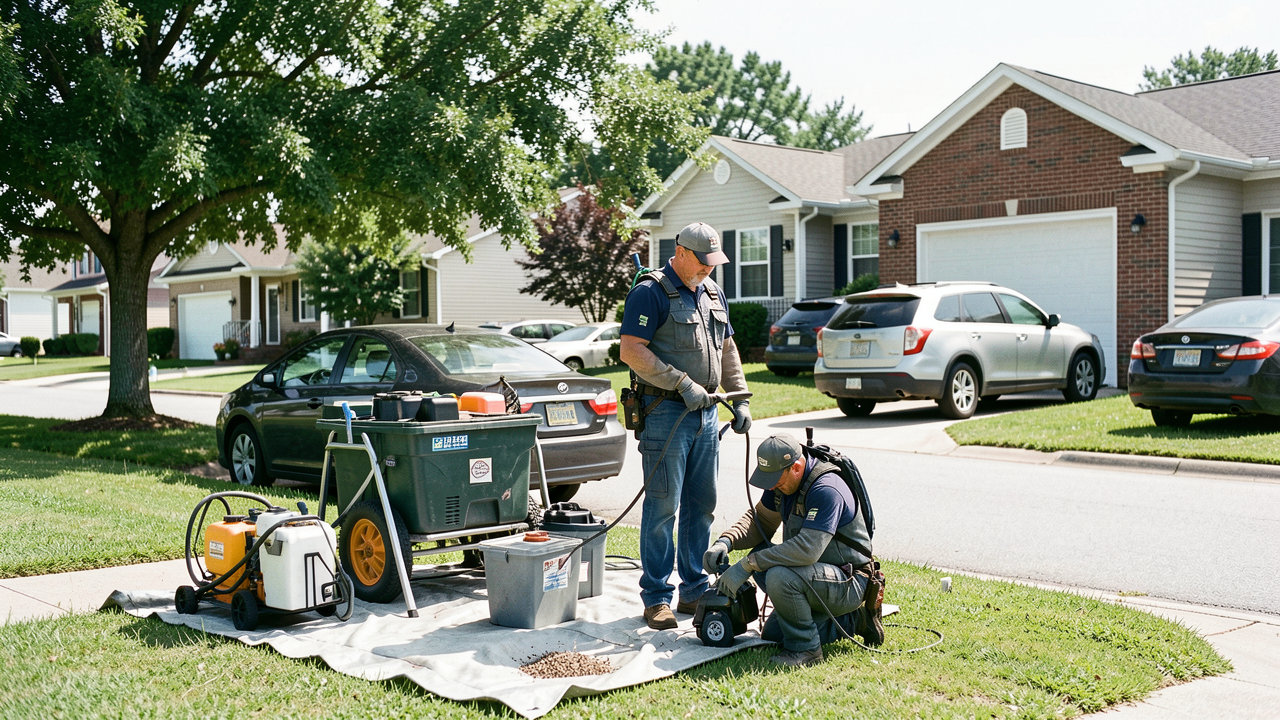
Ants are the pest people put up with longest before calling, partly because a few in the kitchen feels like a housekeeping problem rather than a structural one. In southeast Louisiana it usually isn't. The humid subtropical climate here means ants stay active year-round rather than shutting down over winter, so a trail you notice in January is a working colony, not a stray scout. And the species involved changes the job entirely — a fire ant problem in the yard and a carpenter ant problem in a wall share a name and almost nothing else.
Fire ants announce themselves. Loose, crumbly mounds appear in the lawn, along driveway edges and around utility boxes, and they turn up fast after heavy rain when flooded colonies relocate to higher ground — a common sight on Slidell properties after a few days of storms. The risk is stings, to kids, pets and anyone kneeling in the flowerbed, and the problem is that killing a mound you can see does nothing about the dozen you can't. Effective fire ant treatment works at yard scale: a broadcast bait the foragers carry back to the queens, usually paired with direct mound treatment where there's an immediate hazard near a door, a play area or a shed.
Carpenter ants are a different conversation. They're large, often black or black and red, more active at dusk, and they don't eat wood — they hollow it out to nest in, which is why you may find coarse sawdust-looking frass below a window frame, a soffit or a bathroom wall. Almost every carpenter ant job in this area traces back to moisture: a slow roof leak, a failed flashing, a shower pan, a wet sill plate or a rotting stump or fence post in the yard. There's often a parent colony outside and a satellite colony inside, and treating only the one you found means the other refills it. Worth saying plainly: if you've found damaged wood and assumed ants, get it identified properly. Louisiana has a severe, well-documented problem with Formosan subterranean termites, an invasive species that does far more structural damage than native termites and is harder to control, and mistaking that for carpenter ants costs you months.
The ones that trail across the counter in long lines are usually Argentine, odorous house or crazy ants. These are the species most often made worse by the homeowner. Spraying a repellent product over a trail of a multi-queen, budding species scatters it into several smaller colonies in several new places, and it also contaminates the surfaces that bait needs to reach. If you've already sprayed, say so when you call — it changes how treatment is sequenced and how long it takes to see results.
The visit starts with inspection, not application: finding trails, entry points, moisture sources and nesting sites, then matching the product to the species. Interior work is typically targeted baiting and crack-and-crevice treatment rather than blanket spraying, because baiting is what reaches a queen. Exterior work covers the perimeter, foundation, utility penetrations, mulch beds and any ground contact between vegetation and siding. Carpenter ant jobs may include dusting void spaces and will always include telling you which moisture problem needs fixing — treatment without the repair is a holding action. Fire ant work is scaled to the lot, and large lots in Lacombe and Alton with open ground or a pasture boundary carry heavier reinvasion pressure from neighbouring land.
Price tracks a handful of things: the species and the number of colonies, the square footage of the structure and the size of the yard for broadcast work, how accessible the nesting areas are, whether crawlspace or attic access is needed, and whether one visit will hold or the situation calls for follow-up. We provide free estimates, so you can get that pinned down before committing, and same-day service is available when a sting hazard or an active indoor infestation can't wait. We take a range of payment methods — ask on the call.
Ask whether the technician will identify the species before treating, and what they'll do differently depending on the answer. Ask whether the plan is bait, spray or both, and why. For carpenter ants, ask how they intend to locate the nest rather than just the trail. For fire ants, ask whether the yard gets broadcast bait or only the visible mounds are treated, and what the plan is for reinvasion from the property line. Then ask what you need to do beforehand — usually stop spraying anything yourself, and leave the trail in place so it can be followed.
Call to describe what you're seeing and where. Enquiries come by phone.